
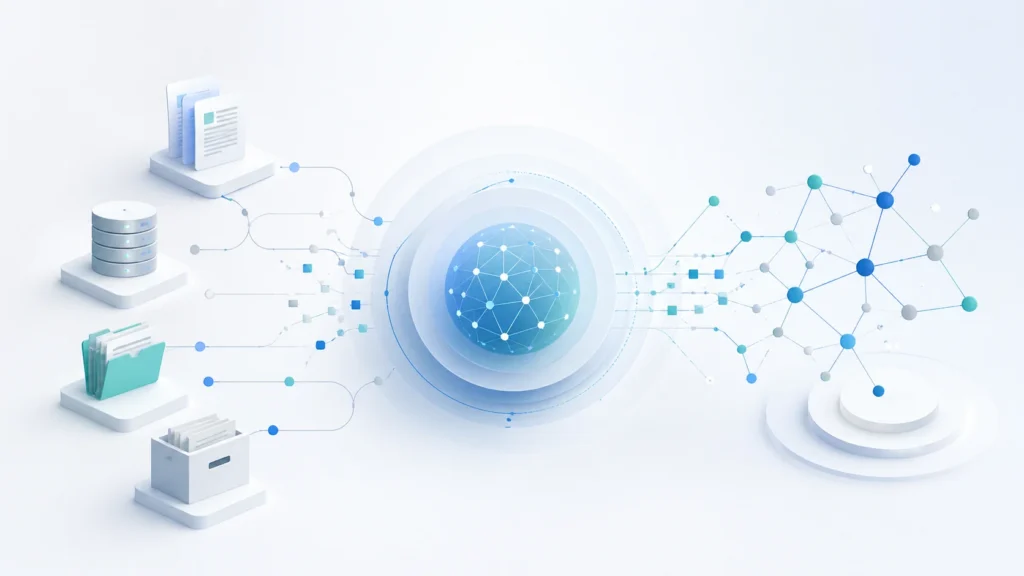
Large language models are powerful, but they are not enough on their own when it comes to company knowledge. Because of this, RAG is becoming one of the ways companies use artificial intelligence in a more up-to-date, more controlled, and more explainable way. In this article, let us talk about RAG based on research in the industry.
Large language models have shown serious potential for companies for some time. They offer an important promise of efficiency in many areas such as faster access to information, content creation, document summarization, question-answer systems, and decision support systems. However, when it comes to enterprise use, these models face two main limits: outdated information and the problem of reliability.
Standard models operate within the boundaries of the period in which they were trained. As a result, they have no direct knowledge of a company’s current documents, new processes, recent decisions, or company-specific knowledge structures. They also continue to be seen as a serious risk area, since they can generate answers that sound convincing but are wrong.
What is RAG (Retrieval-Augmented Generation)?
For this reason, Retrieval-Augmented Generation, or RAG, has started to be discussed more in recent times. In its simplest form, RAG is an approach that allows a large language model to find relevant company data and use it as context before producing an answer. In other words, instead of relying only on its own training data, the model first brings back the related document, record, or data pieces and bases its answer on them. For this reason, we cannot see RAG only as a system that searches. In fact, the goal here is to help the model build a stronger connection with company knowledge.
This approach becomes more meaningful especially when internal company knowledge is updated often, documents are many and complex, quick access to correct information is critical for users, and it becomes important to see the source of the answer that is produced. Because the issue here is not only producing an answer, but also making it more visible what the answer is based on. This difference becomes even more important in a period when the expectation for transparency is increasing. Technical and financial analyses published by Pinecone, Microsoft Research, Google Research, Meta, Zilliz, Actian, and Benchmarkit in the 2025-2026 period also show that RAG is being seen as a more central architectural layer for this reason.
Why is RAG different from classical LLM use?
In classical use, the user asks a question, and the model answers based on the general knowledge it learned during training. But companies have their own documents, processes, decision records, past reports, and current data flows. This information changes all the time and often stays outside the model’s general knowledge. Because of this, RAG tries to close this gap. Instead of training the model again, it finds the related information when needed and brings it into the answer. This increases the chance of producing answers that are more current, more suitable to the context, and often easier to trace.
For this reason, RAG can be understood not just as a technical decision, but also as a way of managing information. After all, within a company, the real challenge is sometimes not running the largest model, but reaching the right information at the right moment.
Why are simple RAG structures no longer seen as enough?
In the early days of RAG adoption, many applications operated in a very simple manner. Documents were placed into a vector database, the pieces closest to the query were retrieved, and the model built an answer from them. Yet enterprise questions frequently cannot be answered just by locating similar text.
Because of this, more advanced architectures are coming forward in 2026. The GraphRAG approach is especially getting attention here. Research on Meta’s GraphRetriever system shows that retrieval structures using knowledge graphs reduce hallucinations by 30 percent. These architectures do not only look at text similarity. They also keep entities and the relationships between them in a way the model can access. This makes it possible to build systems that can connect more than one information point and reach a result. This stands out as a development that strengthens not only accuracy, but also explainability. In the same period, companies moving to more advanced retrieval architectures with a goal of 99 percent precision also supports this change.
Why is RAG still discussed when long-context models exist?
One of the most common questions in research in this area is this: If context windows with millions of tokens are improving, why do we still need a retrieval architecture?
Total cost of ownership analyses from the 2025-2026 period show an important difference here. In the RAG strategy, the cost per query is around 0.00008 dollars, while in the pure LLM approach with a 1 million token context window, this number goes up to 0.1 dollars. This means a difference of around 1250 times. There is also a clear difference in latency. In the RAG architecture, response time is around 1 second, while in the long-context model approach, it can go up to around 45 seconds. In the same comparisons, RAG is associated with filtered and refined data, while the approach that sends all data directly to the model is seen as a noisier structure. This brings forward not only the question of bigger context for companies, but the question of better selected context.
Because of this, understanding why RAG is discussed more often not only in technical terms but also in economic terms pushed me to work on this topic. Especially in high-volume enterprise use cases, giving all data directly to the model becomes harder to defend as scale grows.
Chunking strategy: the hidden variable in RAG quality
One of the most hidden but most critical areas in RAG systems is often the chunking strategy. In other words, how the data is divided. Because it is important not only to find the correct information, but also to find it without breaking its context.
New approaches that stand out in the work of Microsoft Research and Google Research show that fixed-size chunking often damages the semantic integrity of documents. Because of this, methods such as late chunking and semantic chunking are becoming more important. In the late chunking approach, the document is first processed with its full context, and the chunking happens later. It is stated that this method reduces context loss by 35 percent. In a similar way, the recursive chunking approach, which moves through sentence, paragraph, and section levels, is said to provide 12 percent higher accuracy than flat chunking. At first sight, these differences may look technical, but they directly affect the quality of the answer the end user gets. Because incorrectly divided information can cause even the correct source to be used with the wrong context.
Where RAG is going: the shift to agentic RAG
For a long time, RAG was seen like a static information retrieval system. But as of 2026, the agentic RAG approach is becoming more visible. In this structure, the system does not only find related documents. It can also divide the task into smaller parts, move between different sources, and use tools when needed.
What are the hidden costs of RAG?
RAG is often described as a more efficient and more controlled approach. But here too, it is necessary not to think about the cost side only through the first setup. Monthly minimum fees introduced by managed vector database providers such as Pinecone at the end of 2025 have become an important part of this discussion. The 50-dollar base price example for Pinecone is one part of this. More importantly, Benchmarkit data shows that 85 percent of companies estimate AI costs incorrectly at the beginning. The same analyses also point out that when data grows from 10 GB to 100 GB, the cost of the same query can increase by 10 times. This shows that RAG is not a structure that is simply set up and then stays efficient by itself. As data volume grows, query intensity increases, and usage becomes permanent, architectural decisions may need to be reconsidered.
Benchmarkit and related cost analyses show that when query volume goes above 60 to 100 million per month, moving to a self-hosting model can reduce operational costs by 50 to 75 percent. In the same period, it is also stated that PostgreSQL + pgvector based self-hosted solutions can deliver 28 times faster P95 latency than the storage layers of managed services. These findings show that when talking about RAG, it is necessary to look not only at retrieval quality, but also at storage structure, query volume, and total cost of ownership.
When technical and financial findings from 2025-2026 from sources such as Pinecone, Microsoft Research, Google Research, Meta, Zilliz, Actian, and Benchmarkit are read together, it becomes clear that RAG is not only an extra feature for companies, but an important architectural layer that helps company knowledge be used in a more up-to-date, more reliable, and more explainable way. More meaningful results appear when the retrieval method, chunking strategy, data volume, cost model, and use case are evaluated together.