
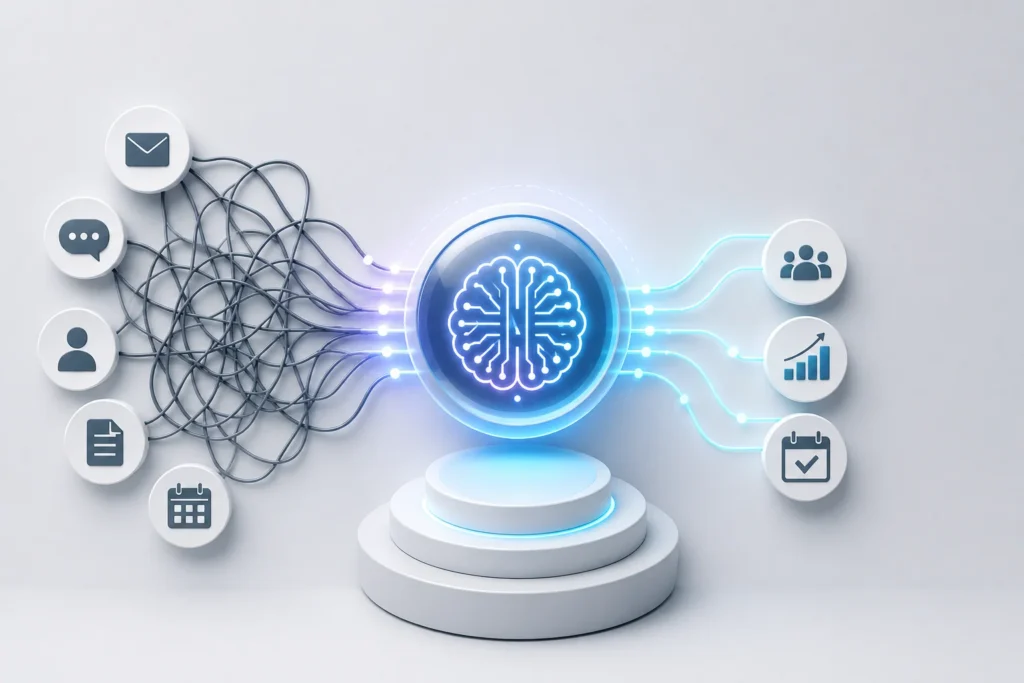
In enterprise software projects with many stakeholders, the biggest problem is often not technical development, but the heavy coordination process between different teams and companies. In systems where mobile, backend, and other parts are developed by separate companies, business analysts and project managers spend a lot of time on important tasks such as requirement gathering, analysis, communication between teams, and budget and time planning. As the process continues, new requirements, delays in approval mechanisms, and continuous feedback cycles increase this workload. As a result, project delivery dates are often delayed by months, for example 4–5 months later than planned. For this reason, in this article I collected my research and thoughts to answer my main question.
How can this coordination load be reduced, and can delay rates in projects be reduced to 5–10% by using artificial intelligence?
Delays are organizational, not technical
At first, when we talk about delays in enterprise software projects, people often blame technical problems. The backend is more complex than expected, the mobile side takes longer, or integrations fail at the last moment…
However, my own experience in the field tells a different story. A big share of delays is not created by code, but by processes where people wait on each other. And as these dependencies grow, the project is no longer a technical problem — it turns into an organizational one.
In enterprise software projects studied in sources like HST Solutions, Velvetech, ProductDock, and Raven Intel, a common pattern appears:
Most delays are not caused by lack of technical ability, but by organizational friction. This friction becomes stronger in multi-stakeholder systems:
- Mobile team in a different company
- Backend team in a different company
- QA and DevOps in different organizations
- Business units in different countries
- Multi-level approval systems
The common problem of these structures is this:
Information flow becomes more fragile than system architecture.
The main reasons for delays found in research are:
- Wrong or incomplete requirement gathering
- Waiting in approval processes
- Communication gaps between teams
- Wrong integration assumptions
- Loss of information and lack of organizational memory
In particular, it is said that requirement errors create around 30–40% rework during development.
(See HST Solutions, ProductDock analysis)
What is the coordination tax?
One of the most important wrong assumptions in enterprise projects is this idea: “Teams write code, everything else is support work.”
Productivity studies from MIT Sloan and similar research show that knowledge workers spend a large part of their time not on producing, but on coordination activities.
This coordination layer includes meetings, requirement clarification, status reports, email communication, dependency tracking, and approval processes.
The main idea I focus on is explained like this:
Most of the time is not spent on production, but on communication about production.
Similarly, in PMO processes, sources like KnowledgeHut show that project managers spend about 40–50% of their time on reporting and data collection. At this point, a concept appears: Coordination Tax.
In enterprise projects, every new team, system, supplier, or approval layer adds extra coordination cost to the project. And this cost is not linear, it grows exponentially.
How small delays compound into months
Let’s think of a simple example:
- Requirement approval waits 3 days,
- API contract is delayed 5 days,
- A dependency waits 1 week,
- A decision stays in approval queue for 2 weeks,
- An integration assumption breaks at the final stage.
Taken alone, each of these looks minor. But when they add up, the project can slip by 2–5 months.
Research shows these points:
- API and integration uncertainty can contribute about ~30% of delays
- Wrong requirement management creates 30–40% rework
- Communication gaps affect 20–30% of total delay
(See Raven Intel, Velvetech, ProductDock analysis)
The main problem here is not technical:
It is the delay of decisions and information.
Artificial Intelligence Opportunity: Not Code, But Flow Speed
In this part, we agree that one of the strongest early signals of delay is requirement variability. Frequent changes in project specifications are a sign of misalignment between stakeholders and a signal of future rework cost. Research shows that with correct tracking of metrics, 63% of highly variable requirements can be detected early.
AI models (Random Forest, XGBoost, Bayesian Networks, etc.) can detect risks by analyzing historical project data together with real-time flow metrics. Academic work shows that such AI-based systems can achieve 94% accuracy in risk detection and lift sprint completion rates by 18%.
Risk signals are not only in numbers, but also in words. Natural Language Processing (NLP) tools scan Slack messages, Jira comments, and stand-up notes to detect frustration in the team. Words like “waiting” or “blocked” and changes in sentiment help identify problems early before they grow.
The Organizational Digital Twin (DTO)
Right now, AI is mainly applied to risk detection and decision support. But there is a larger vision: systems that can digitally model the entire organization. This concept is known as the Organizational Digital Twin (DTO).
DTO aims to combine teams, processes, dependencies, and past decisions into one model to simulate the impact of changes.
The success of DTO depends on combining data from different tools like Jira, GitHub, Confluence, Slack, and ServiceNow. Modern systems use GraphRAG (Graph-Augmented Retrieval-Augmented Generation) to model these relationships and reduce hallucinations by using real organizational data.
In the next 5–10 years, project management is expected to move from reactive crisis management to proactive simulation management.
Impact Analysis: When a stakeholder requests a new feature, the AI system could immediately respond: “Adding this feature will delay the main delivery by 18 days and create a bottleneck in team B. Do you approve?”
Autonomous PMO: By 2030, it is expected that 80% of routine coordination and reporting tasks will be done by digital agents.
Self-optimizing systems: With reinforcement learning, projects will learn from each sprint and automatically adjust resource allocation based on real conditions.
The barriers: data quality and trust
The largest obstacle for these technologies is data quality. The rule “Garbage in, garbage out (GIGO)” still holds; in 70% of organizations, models fail due to poor data quality. In addition, such systems may be perceived as surveillance tools, which can damage employee trust. AI should act not as a decision maker, but as a strategic coordinator.
Current research shows that AI cannot fully remove coordination cost, but it can improve early risk visibility, requirement quality, and decision speed. Therefore, while 5–10% delay levels are ambitious today, there is strong potential in reducing organizational friction.
From code speed to decision speed
In enterprise software projects, the real bottleneck today is no longer how quickly developers write code, but how quickly and correctly the organization reaches decisions. AI and DTO technologies do not exist to replace managers, but to support them in handling complexity.
In the future, successful organizations will not only be the ones with the best developers, but the ones that can support decision-making with data.
This article is based on more than 50 recent academic and industry studies on AI-powered project management, DORA metrics, and organizational digital twins.
References
- AI-Driven Decision Support Systems in Agile Software Project Management: Enhancing Risk Mitigation and Resource Allocation https://www.mdpi.com/2079-8954/13/3/208 .
- Enterprise Digital Twin Architecture: Implementation Guide for AI Systems https://ajithp.com/2026/01/11/enterprise-digital-twin-architecture-implementation-guide/ .
- Predicting delays in software projects using networked classification https://seanalytics.github.io/papers/ASE2015-preprint-choetkiertikul-dam-tran-ghose.pdf.
- Predicting Requirements Volatility: An Industry Case Study https://ceur-ws.org/Vol-3062/Paper08_QuASoQ.pdf.
- Review Latency | minware https://www.minware.com/guide/metrics/review-latency .
- Why Predictive Analytics Fails: Data Quality, Model Decay – AGIX Technologies https://agixtech.com/insights/why-predictive-analytics-fails-data-quality-model-decay-the-decision-gap/ .
- Top 5 AI Techniques for Predicting Project Delays https://agileseekers.com/blog/top-5-ai-techniques-for-predicting-project-delays .
- Planning Fallacy – The Decision Lab https://thedecisionlab.com/biases/planning-fallacy .
- Digital Twins of an Organization: why worth it and why now – SAP Signavio https://www.signavio.com/post/digital-twins-of-an-organization-why-worth-it-and-why-now/ .