ProductsArtificial IntelligenceProactive Insight
Deeper team insight without bothering a single person.
Regentis reads status straight from the work itself and flags what needs attention early — proactive insight without interrupting anyone. What lands is a daily digest and period summary per team, with highlights, risks, and the context behind them.
The same day, run twice.
Here is next Tuesday — once as it goes today, once with status read from the work instead of the room.
Standup spends twenty minutes on status — each person reports what they believe, and the risk that matters never comes up.
COSTS · twenty minutes of fictionStatus was posted to the channel before the meeting — read from PRs, tickets, and builds. Standup starts at blockers.
INSTEAD · standup starts at blockersA stakeholder pings “quick status on the migration?” You context-switch, chase two leads, and assemble an answer by hand.
COSTS · three people interruptedYou paste the digest: per-team status with highlights and risks, current as of this morning. Nobody was asked anything.
INSTEAD · answered without asking anyoneThe week ends and the risk that mattered — a PR stuck behind review since last week — surfaces in Friday’s retro, too late.
COSTS · a week of quiet driftThe digest flagged it days ago, while it was still cheap: highlighted as a concern, with the context attached.
INSTEAD · flagged while still cheapStatus meetings report beliefs — the work reports facts.
It reads the work, so nobody has to report it.
- The trigger — it watches the work itself, continuously.Regentis reads pull requests, tickets, builds, and incidents across your connected stack — no check-ins, no pings, no forms for anyone to fill.
- The work — it assembles per-team status and looks for risk.Activity over the window you choose — 1 day, 3 days, 1 week, or 2 weeks — is assembled into per-team engineering status, with concerns highlighted while they’re still cheap to fix. It reads work artifacts, never individual performance.
- The artifact — digests and summaries land where you work.Daily digests and period summaries with highlights, risks, and context — plus an AI snapshot of any window, for any team, group, or the whole org.
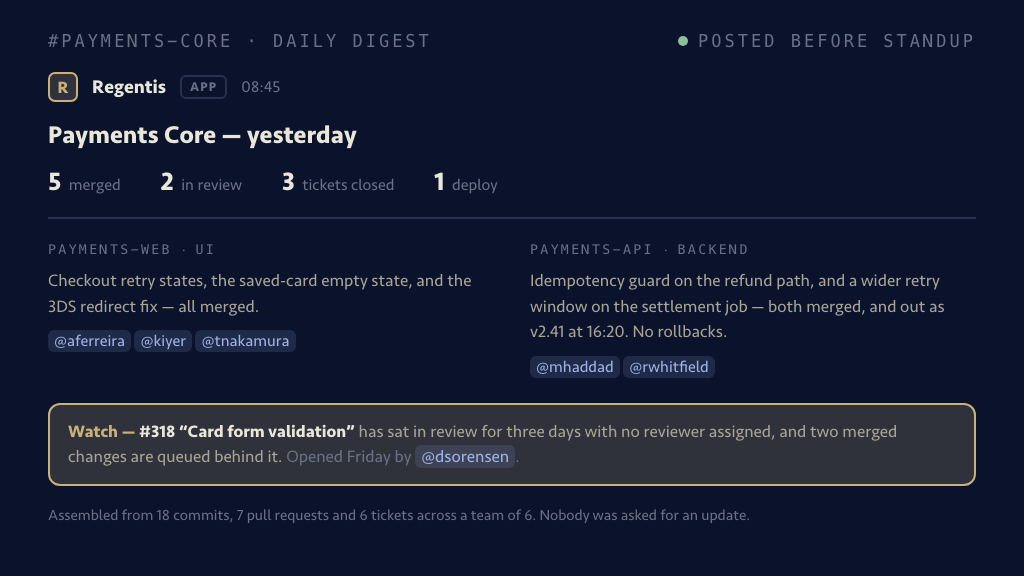
The morning read, already written.
Per-team status with highlights and risks, delivered where you work before the day starts — the reason standup can begin at blockers instead of updates.
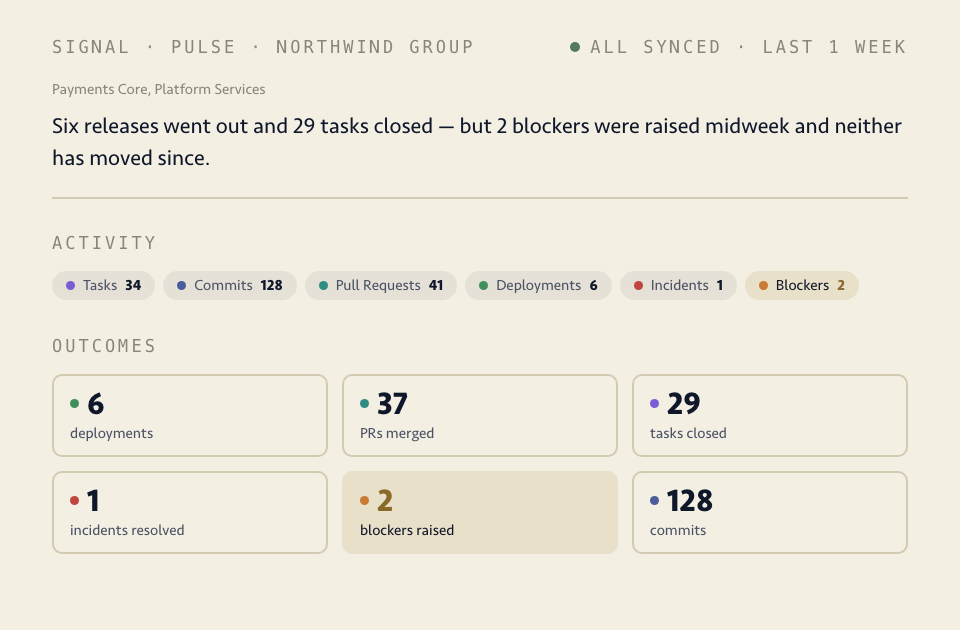
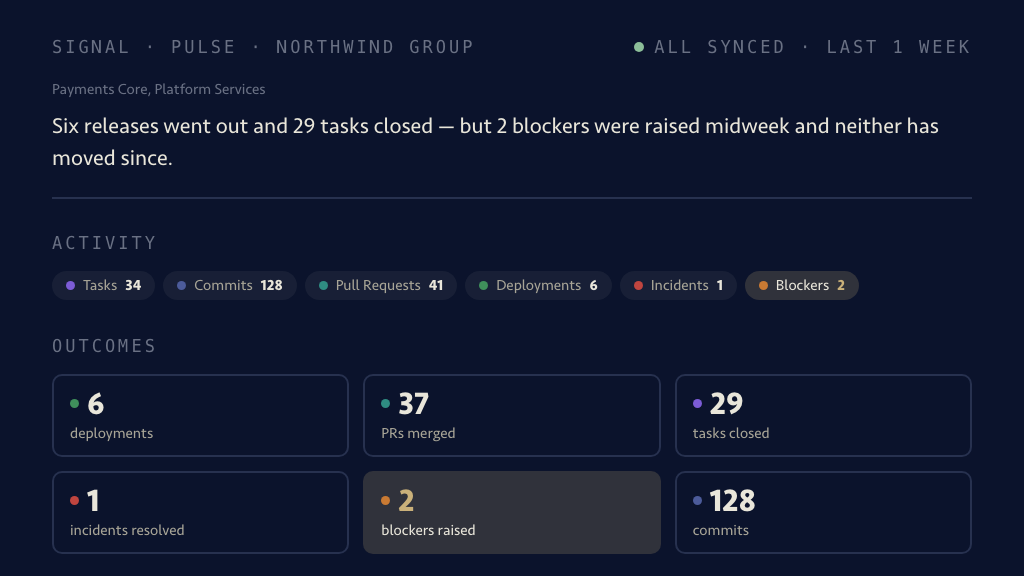
Team activity over a selectable window — 1 day to 2 weeks — with the AI snapshot of what changed and what to watch, for any team, group, or the org.
Fair questions, answered plainly.
Is this surveillance of my engineers? +
The concern is legitimate — this category has shipped surveillance before. Proactive Insight reads work artifacts (PRs, tickets, builds, incidents) and assembles team-level status; there are no individual scores anywhere in Regentis, as stated policy. It reports on the delivery system, not on people.
Our board is always stale — won’t this just report the stale tickets back to us? +
If it only read the board, yes. It also reads pull requests, builds, and incidents — signals that exist whether or not anyone groomed a ticket — so one neglected backlog doesn’t get to decide the story. The digest reflects what the systems saw happen, not what someone remembered to update.
How is this different from a Slack status bot? +
A status bot asks people and forwards their answers — it automates the interruption. Proactive Insight doesn’t ask anyone anything: it reads the work, assembles the status, and flags the risks with context attached. The difference shows up in what the digest contains — evidence, not self-reporting.
Do we still need standups? +
Yes — and they get better, which is the point. When status is already posted before the meeting, the meeting stops being a readout and starts at blockers and decisions. Teams that love their standup keep it; it just stops costing twenty minutes of recitation first.
Tomorrow’s standup can start at blockers.
Connect the stack today and the first per-team digest lands before tomorrow’s standup — nobody fills in anything.