ProductsArtificial IntelligenceThe @regentis Agent
Regentis doesn’t just write code, it proves it works.
Mention @regentis wherever the work lives — a task ticket, an ITSM ticket, a pull request, Slack, or Teams — and it takes the ask from there. The work comes back done with the evidence attached; for a code fix, that’s a pull request with the recording proving it works.
The same day, run twice.
Here is the Tuesday the asks pile up — once as it goes today, once with @regentis on the mention.
QA files the bug with a clean repro. It joins the backlog behind everything else — the fix is somebody’s next sprint, maybe.
COSTS · a sprint of waitingQA mentions @regentis in the ticket comment. The work is taken and under way while standup is still going.
INSTEAD · taken, already under wayA technical report lands on the service desk: exports failing for one customer. It bounces between support and engineering while everyone asks who owns it.
COSTS · two queues, no ownerSupport mentions @regentis on the ITSM ticket. It investigates the report and returns findings to the thread — an actionable ticket for the owning team.
INSTEAD · investigated, findings attached“Can someone quickly check why the staging build is red?” sits in the team channel until somebody sacrifices their evening to chase it.
COSTS · someone’s evening focus@regentis is mentioned on the thread; the answer comes back in the channel with the evidence behind it. Nobody context-switched.
INSTEAD · answered in the threadThree asks, three surfaces — one mention handled them all.
Mention it, and it takes the ask from there.
- The trigger — a mention, wherever the work lives.In a task ticket, an ITSM ticket, a pull-request comment, Slack, or Teams — the mention is the handoff, and the ask is whatever you’d hand a capable teammate: fix this, investigate this, find out why, address this feedback.
- The work — it handles the ask, grounded in your org’s context.It works out what the ask needs and gets it done — investigating, answering, or making the change; code changes are built and run in a dedicated sandbox and verified end to end. Nothing irreversible happens without your sign-off.
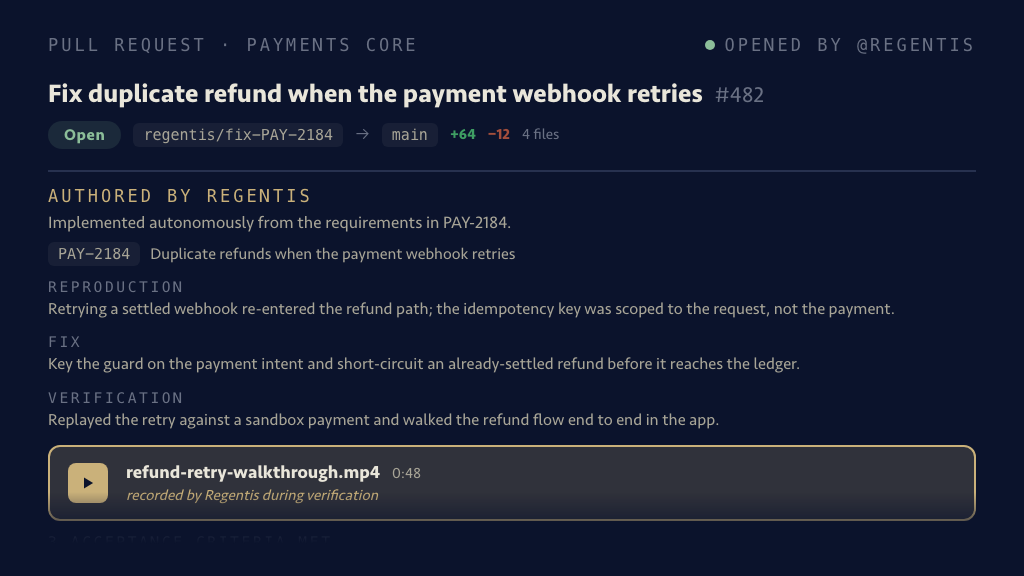
- The artifact — the finished work returns where you asked.Findings on the ITSM ticket, the answer in the thread, the feedback addressed on the PR — and when the ask was a fix, a grounded pull request with screenshots and the screen recording proving the flow works.
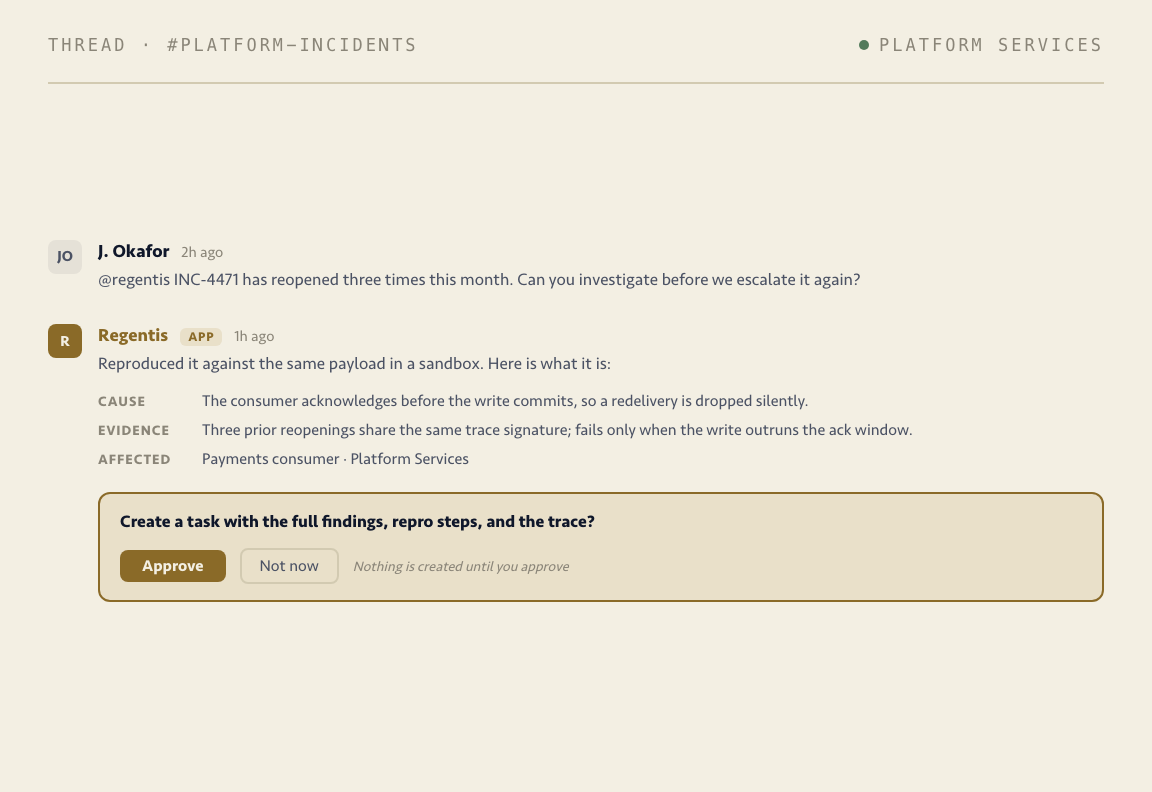
The work comes back where you asked.
When the ask was a fix: a reviewable PR with its evidence attached — the reproduction, the change, the verification steps, and the screen recording of the app running the flow. This is the artifact behind the headline.
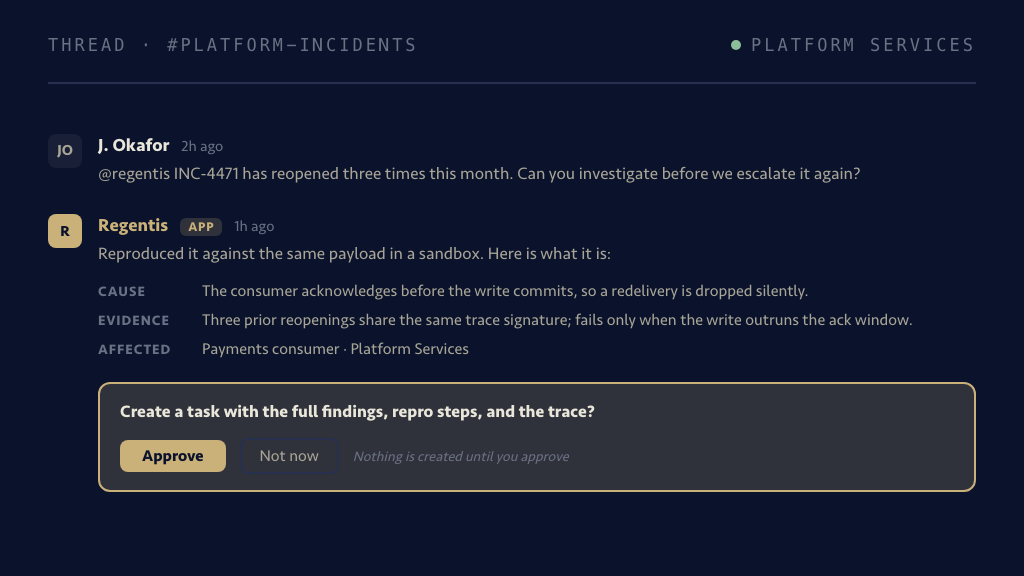
For every other ask: the comment trail where a mention became finished work — the ITSM report returned as a ticket with findings, the question answered in the channel with its evidence, the handback ready to action. And when the work does go to a human, the handoff carries the full context — what was asked, what was found, what remains — instead of dumping the requester back into a channel.
Fair questions, answered plainly.
Is this only for coding work? +
No — the mention is a front door, not a code command. Ask it to investigate a technical ITSM report, chase down why something is failing, or address the feedback on a PR, from whichever tool the ask already lives in — task ticket, ITSM ticket, pull request, Slack, or Teams. The result returns where you asked; code changes are simply the case where the proof arrives as a recording.
How do I verify an AI-generated fix actually works, beyond tests passing? +
You’re right not to accept a green check — tests passing is a claim about the tests, not the fix. That’s why @regentis runs the change in a sandbox and navigates the actual flow, then attaches the screenshots and recording to the PR. And because it’s contributor-invoked, it works the asks you hand it — your review starts from evidence, not from a firehose of unrequested PRs.
Can an AI agent be trusted with write access to our repositories? +
It shouldn’t be trusted implicitly — so it isn’t given that position. Code work happens in a dedicated sandbox, output arrives as a pull request like any contributor’s, nothing merges without your review and sign-off, and everything it did is in the pull request for you to see. Autonomous, never unaccountable.
Who can actually use it? +
Any contributor, from the tool they already use: a QA engineer hands it the bug they just filed, a developer hands it the feedback on a PR, a PM hands it a ticket and gets a verified fix back for review, a service-desk owner hands it the technical report nobody could place. Nobody logs into anything — the mention is the whole interface.
The next ask can be @regentis’s problem.
Connect your stack, mention @regentis where the work already lives, and the first result comes back with the evidence attached.