ProductsArtificial IntelligenceAI Automation
Automation that already knows how your org works.
Set up automations that run unattended in the cloud, harnessed with your organization’s engineering knowledge space — so routine work gets done without anyone driving it. What lands is the finished work — tickets routed, severities corrected, requesters answered, status posted — in the tools where the work lives.
The same day, run twice.
Here is next Tuesday — once as it goes today, once with the automations switched on.
The overnight queue is waiting: inbound tickets, a few misfiled as low severity, one customer-facing. Your senior engineer spends the first hour triaging instead of building.
COSTS · your best engineer’s morningThe queue was triaged before you sat down — routed to the owning teams, severities corrected, one requester already answered from org context.
INSTEAD · triaged, routed, answeredA new ticket lands: one line, no repro, no component. It bounces between two teams in the comments while everyone guesses.
COSTS · two teams, one guessThe same ticket arrived enriched — codebase context, the likely component, the related incident linked — before anyone read it.
INSTEAD · enriched before first read“Can you send status before standup tomorrow?” You spend the evening reconstructing the week from the board.
COSTS · the evening, againTomorrow’s status is already scheduled: posted to the team channel before standup, derived from the week’s actual activity.
INSTEAD · posted before standupThe busywork still happened — just not to anyone.
Compose automations from agents that already carry your org’s context.
- The trigger — a schedule, or an event from your stack.Regentis automations run on a schedule or fire on events from any integrated platform — a PR opened, a ticket created, a monitoring alert raised, a date reached.
- The work — an agent from the catalog does the job, on org memory.Each automation is composed from a curated library of agents — code review, task enrichment, APM triage, ITSM triage and deflection, status, project, and financial reporting — acting on context assembled from your code, tickets, incidents, CI/CD, and docs, inside the boundaries you set.
- The artifact — the loop closes where the work already lives.The ticket is routed, the severity corrected, the requester answered, the status posted — each landing in the tool that already holds the work, inside the access the automation declared before it ever ran.
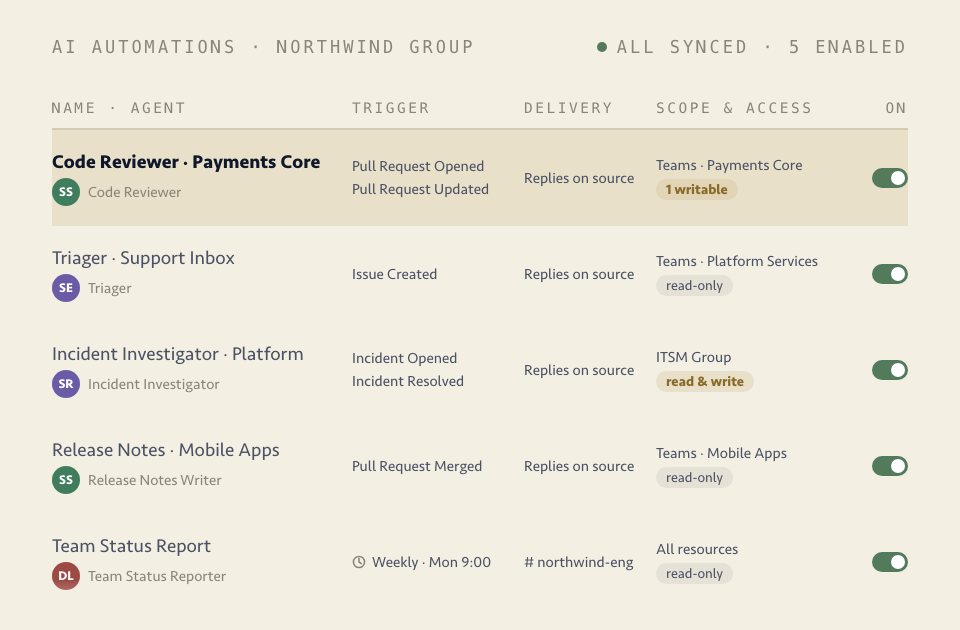
The finished work, and the boundary it ran inside.
A ticket that arrived misfiled, unowned, or answerable — now re-prioritized, routed to the owning team, or answered directly in the tool it lives in, before a human touched it.
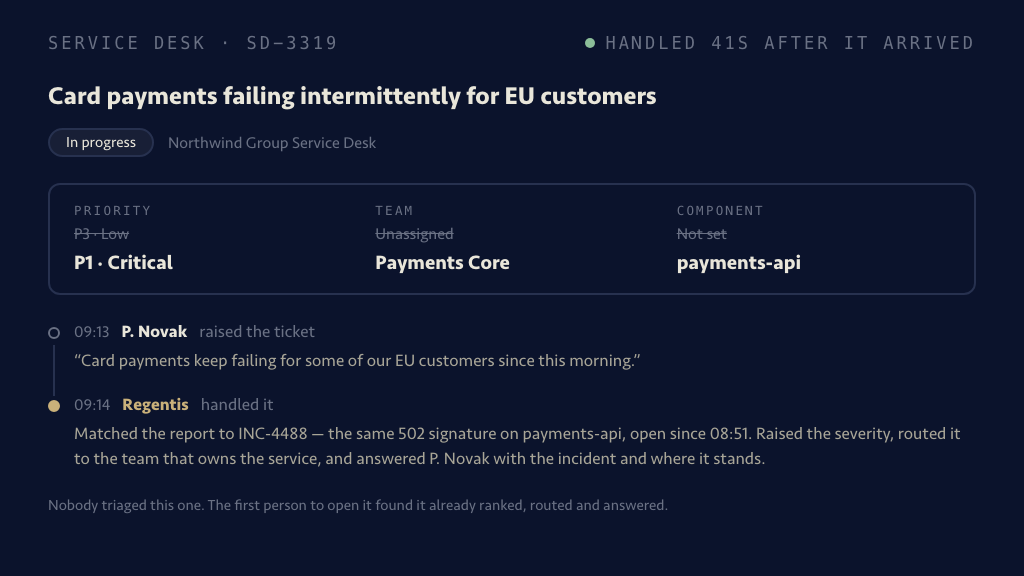
The configuration behind every automation: what triggers it, which agents it runs, and what it is allowed to touch — the thing you open when anyone asks “what can this actually do?”
Fair questions, answered plainly.
Should we just build this ourselves? Our team is already writing in-house agent skills. +
Building works — teams are doing exactly this, and at first it’s genuinely fine. What breaks at scale is everything around the skill: the context drifts as the org changes, and nobody owns it when its author leaves. Regentis ships the same catalog as a product — on continuously assembled org memory, with sign-offs where you want them — so the automation survives the person who set it up.
We tried our ITSM’s built-in AI and people routed around it. Why would this be different? +
The usual diagnosis is right: deflection grounded in a hand-curated knowledge base fails the moment the KB goes stale — and it always goes stale. Regentis grounds triage and answers in org memory assembled from your tickets, code, incidents, CI/CD, and docs — the systems of record themselves, not articles someone has to maintain. When a ticket does need a human, the handoff carries the full context rather than dumping the requester back into a channel — the failure that gets deflection bots routed around. And it’s a layer over your existing ITSM, not a rip-and-replace.
What happens when an automation gets something wrong? +
It will, sometimes — which is why accountability is the design, not a feature. Each automation works inside boundaries you set, nothing irreversible happens without your sign-off, and what it did is right there in the open — the routed ticket, the written comment, the posted status. Autonomous, never unaccountable.
Is this just AI code review with extra steps? +
No — code review is one agent in the catalog, and several agents never touch a repo. Task enrichment, APM triage, ITSM triage and deflection, status and project reporting, financial reporting: the point is one automation layer with shared context across the whole engineering operation, instead of a separate subscription and a separate context for each lane.
The queue can triage itself tomorrow morning.
Connect your stack, compose an automation from the catalog, and the first actions land the same day — in the tools where the work lives.